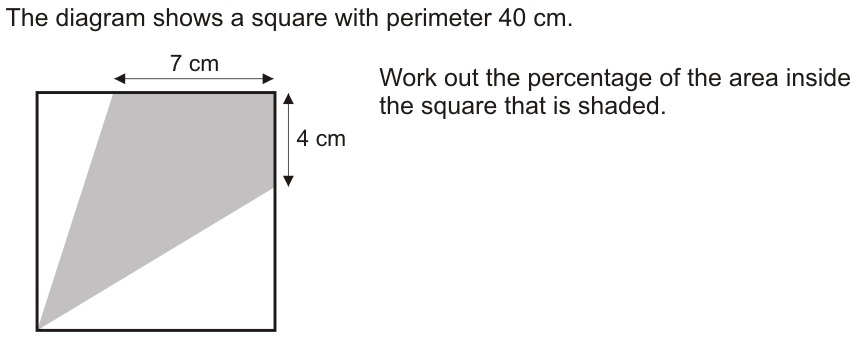
Side of the square is 10 cm area = 10 x 10 = 100 cm2
Upper left triangle area = 1/2 bh = 1/2 3 x 10 = 15 cm^2
Lower right triangle area = 1/2 6 x 10 = 30 cm^2
Total UNshaded area = 45 cm^2
Then shaded area = 100 -45 = 55 cm^2 out of 100 cm^2 = 55 %
Using Pythagorean Theorem for the diagonal (hypotenuse) s = side length
s^2 + s^2 = (sqrt2)^2
2 s^2 = 2
s^2 = 1
s = 1 (unit)
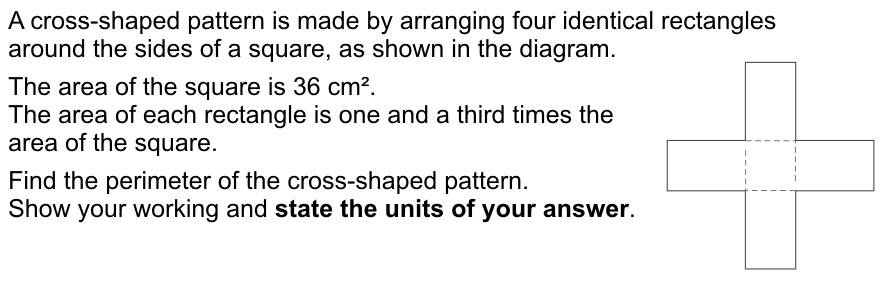
Side of square = side of rectangle = 6 cm
area of rectangle = 4/3 (36 ) = 48 cm^2 so length of rectangle = 8 cm
Perimeter = 8 (8cm) + 4 (6cm) = 88 cm
4/5 * 10/7 = 40 / 35 = 1 5/35 = 1 1/7
Answer given above does not really help YOU learn how to solve it does it?....here is method:
Area of larger rectangle = (9+b) * a = 84
smaller rectangle = a*b = 21 so b = 21/a subst this into the first equation
(9+21/a)*a = 84
9a + 21 = 84
9a = 63
a = 7 since we arwe given a*b = 21 then b = 3
= (infinity)
7.5rev/min x 2pi R/rev = 15 pi R/min
9.75 x angular v = linear v = 9.75*15pi = 146.25pi ft/min
15 pi R /min x ? min = displacement
11 is 1/2 of the other triangle 22
perimeter wil be 1/2 of the larger triangle....
https://web2.0calc.com/questions/please-help-me-i-really-really-really-really-need-help
Tan is sin/ cos whenever cos = 0 tan is undefined (you cannot divide by 0 ) .....do you know when that is?