 +118742
  +118742
 Calamitous Clod rolls a pair of rigged dice. The probability of rolling k on a die is directly proportional to k.
What is the probability that the sum of Calamitous Clod's dice is equal to 7?
Mmmm. Am I supposed to assume that these are 6 sided dice?
Prob(rolling1) = k Where k is less than 1
Prob(rolling 2) = 2k
P(3) = 3k
..
P(6)=6k
k(1+2+3+4+5+6)=21k
21k=1 so
\(k=\frac{1}{21}\)
| 1 | 2 | 3 | 4 | 5 | 6 | |
|---|---|---|---|---|---|---|
| 1 | 2 | 3 | 4 | 5 | 6 | 7 |
| 2 | 3 | 4 | 5 | 6 | 7 | 8 |
| 3 | 4 | 5 | 6 | 7 | 8 | 9 |
| 4 | 5 | 6 | 7 | 8 | 9 | 10 |
| 5 | 6 | 7 | 8 | 9 | 10 | 11 |
| 6 | 7 | 8 | 9 | 10 | 11 | 12 |
\(P(throwing 7) \\ = 2[P(1,6)+P(2,5)+P(3,4)]\\ =2[ k*6k + 2k*5k + 3k*4k]\\ =2k^2 (6+10+12)\\ =56k^2\\ =\frac{56}{441}\\ =\frac{8}{63}\)
You need to check what I have done.
It has been pointed out to me that k is the number on the die. I should have used a different letter for the proportionality constant.
If you change all my k's to a different letter, it would be a much better answer 

+118742 Yes that is all correct.
Yes can you see that if you move the sinx curve pi/2 radians (90degrees) in the negative direction that it will be EXACTLY the same as the other curve?
The parent curve that you have been working on so far is y=sinx
It passes through (0,0) on it way up. The x axis is its centre line.
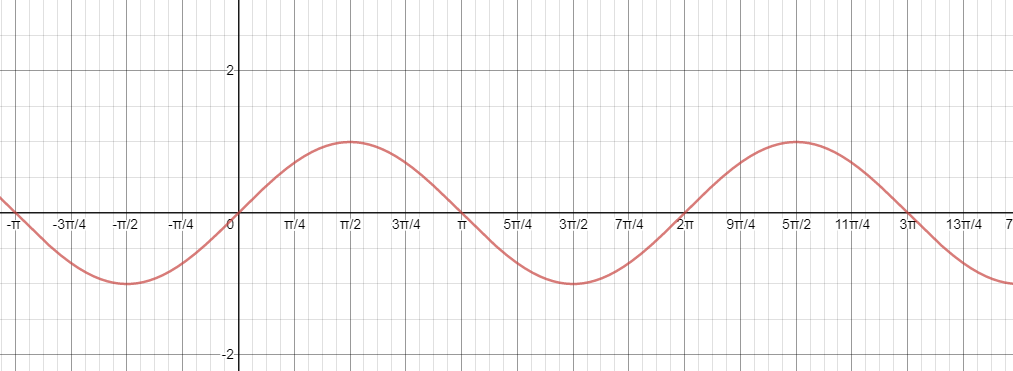
The new curve (which will be a different parent curve) is y=cosx.
It passes through (0,1) which is at the very top of the wave. The x axis is its centre line too.
You must memorise these two curves.
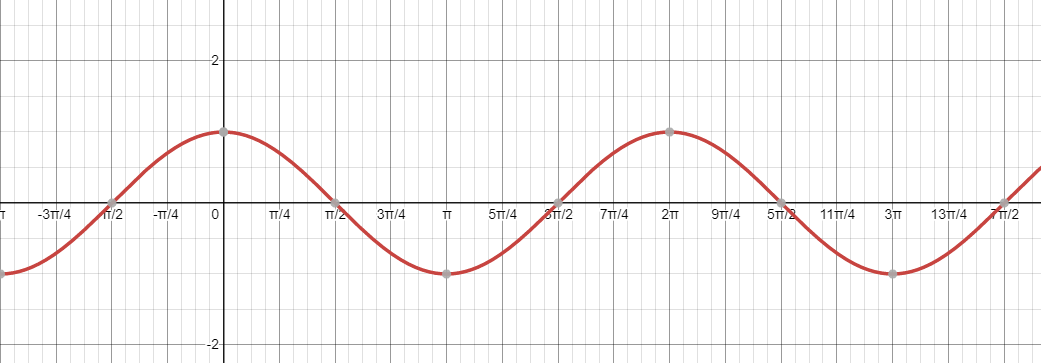
The equation of the cosine curve behaves the same as the sine curve.
Fill out this table and hand graph each one seperately as you do so.
eg
| y=2sinx+3 | y=2cosx+3 | |
| wavelength | ||
| midline | ||
| amplitude | ||
| y intercept (careful) | ||
NOW you have your hand sketches, check them with desmos.