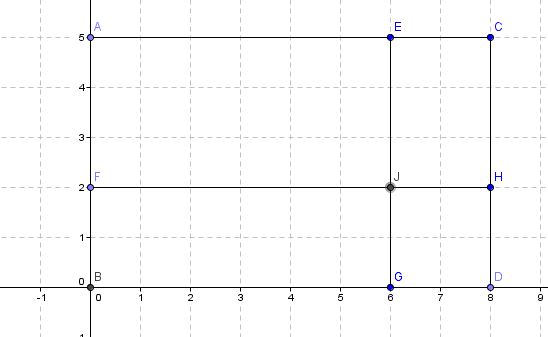
Actually......here's the reason for this.........
Let's suppose that we have a rectangle divided into 4 smaller rectangles of equal sides of "m" length and "n" height.....
And the exact center of the rectangle will be at (n, m).....
Now...for instance...let us shift this point down x units and to the right by y units
Drawing two lines parallel to the sides of our original rectangle through this point will produce four new rectangles.......
So.......the perimeter of the original top left rectangle will increase by 2x + 2y units
And the perimeter of the original bottom right rectangle will decrease by 2x + 2y units
And the height of the original rectangle on the top right will increase by y units but the width will decrease by x units.......so......the new perimeter is 2(m+n) - 2x + 2y units
Finally, the height of the original rectangle on the bottom left will decrease by y units but the width will increase by x units..........so......the new perimeter is 2(m+n) + 2x - 2y units
So.....the sum of the perimeters of the top left and bottom right rectangles will be :
2(m +n) + 2x + 2y + 2(m + n) -2x - 2y = 4 (m + n)
And.....the sum of the perimeters of the top right and bottom left rectangles will be :
2(m +n) - 2x + 2y + 2(m + n) +2x - 2y = 4 (m + n)
So........the sum of the perimeters of the diagonally situated rectangles will be exactly the same !!!