I mucked around with this quite a bit before I came up with a solution.
First I did the division and found \(f(x)=3(x^2+3)+\frac{3(-3x-5)}{x^2+x-2}\)
If I add \(-3(x^2+3)\)
then the resulting expression will be \( \frac{3(-3x-5)}{x^2+x-2}\)
Now with this latest expression the degree of the numerator is 1 and the degree of the denominator is 2
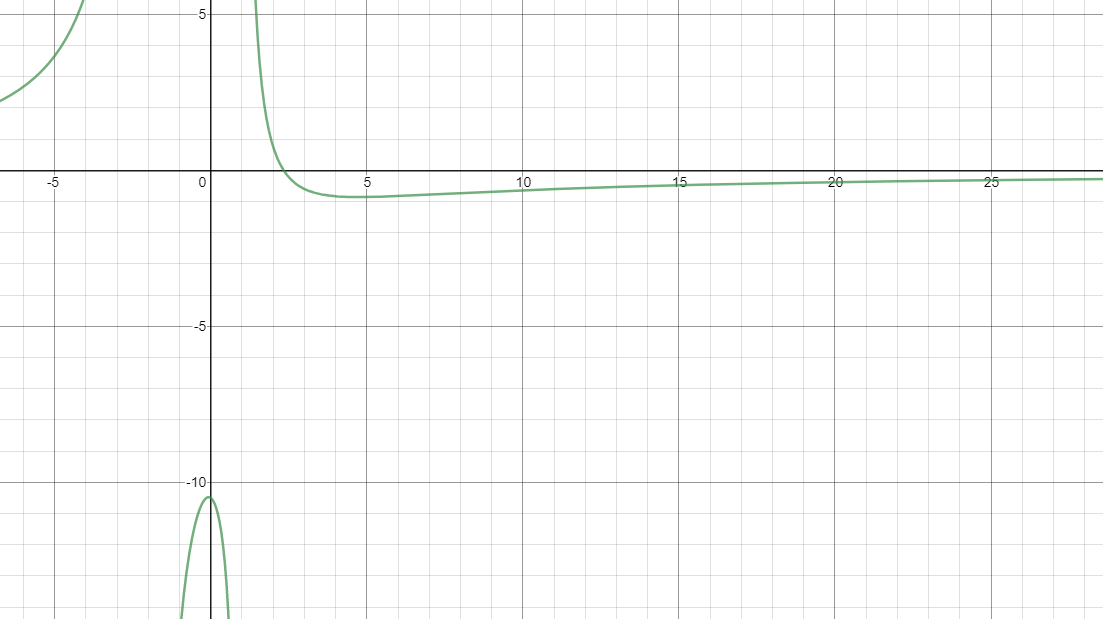
As x tends to infinity both the numerator and the denominator tend to infinity also but the bottom is approaching infinity at a much faster rate (since the degree is higher.) so the expression will tend to 0 as x tends to infinity.
Hence one solution is \(g(x)=-3x^2-9\)
\(\displaystyle \lim_{x\rightarrow\infty}\;f(x)+g(x)=0^-\)



 +118742

